Sales Success Creates Delivery Strain
New customers keep arriving, but delivery capacity cannot expand without adding pressure, inconsistency, and cost.
Winning new business is exposing weaknesses in B2B SaaS customer onboarding and implementation delivery—the post-sale path from promise to value. Experienced people become bottlenecks, implementations slow, and leadership does not see the pattern until customers do.
See where delivery capacity is breaking down before your customers do—before growth outpaces your ability to scale customer onboarding.
A 10-minute assessment of your organization’s delivery capacity.
Growth is placing increasing pressure on delivery.
Delivery depends too heavily on experienced people, while weak visibility prevents leadership from identifying problems early.
Delivery problems rarely appear as a single obvious failure. They emerge as recurring SaaS implementation challenges—customer onboarding bottlenecks, delayed time to value, and delivery capacity that cannot keep pace with growth—that seem unrelated but usually share the same underlying cause.
New customers keep arriving, but delivery capacity cannot expand without adding pressure, inconsistency, and cost.
Launch dates move, projects accumulate, customers lose patience, and revenue takes longer to become real.
Experienced staff become the default trainers, problem-solvers, escalation managers, and protectors of important customer relationships.
Important knowledge and judgment live inside individuals rather than within a system the organization can reliably use.
Leadership learns through an escalation, an angry customer, a missed commitment, or a renewal conversation rather than through reliable operating signals.
Unresolved implementation issues move downstream, leaving Customer Success to absorb adoption problems, frustration, and renewal risk.
The pattern: These are not six independent problems. They are recurring symptoms of the same operating system becoming overloaded. Treating individual symptoms may provide temporary relief, but the pattern will continue until the underlying delivery system becomes visible.
The visible problems may begin inside implementation, but the real exposure appears elsewhere: in revenue quality, margins, retention, leadership capacity, and the organization’s ability to scale.
The company may continue closing business while activation, adoption, and expansion lag behind. Growth looks healthy in the pipeline but becomes less reliable after the sale.
Exceptions, intervention, recovery work, and informal coordination quietly increase the true cost of delivery—even when the original project budget appears intact.
Confidence is shaped during the first delivery experience. When that experience is slow, inconsistent, or difficult, Customer Success inherits a relationship already carrying doubt.
Senior people are repeatedly pulled into decisions, escalations, and customer recovery. The organization appears to scale, but only because leadership keeps absorbing the complexity.
The problem is not simply that delivery is busy. The problem is that growth is becoming increasingly dependent on effort, judgment, and executive intervention that the organization cannot multiply.
Most delivery problems do not begin because people are incapable or unwilling. They emerge when growth outpaces the operating system that supports the work.
As volume and complexity increase, knowledge, execution, decisions, and operating signals must move out of individual memory and informal coordination into a managed system.
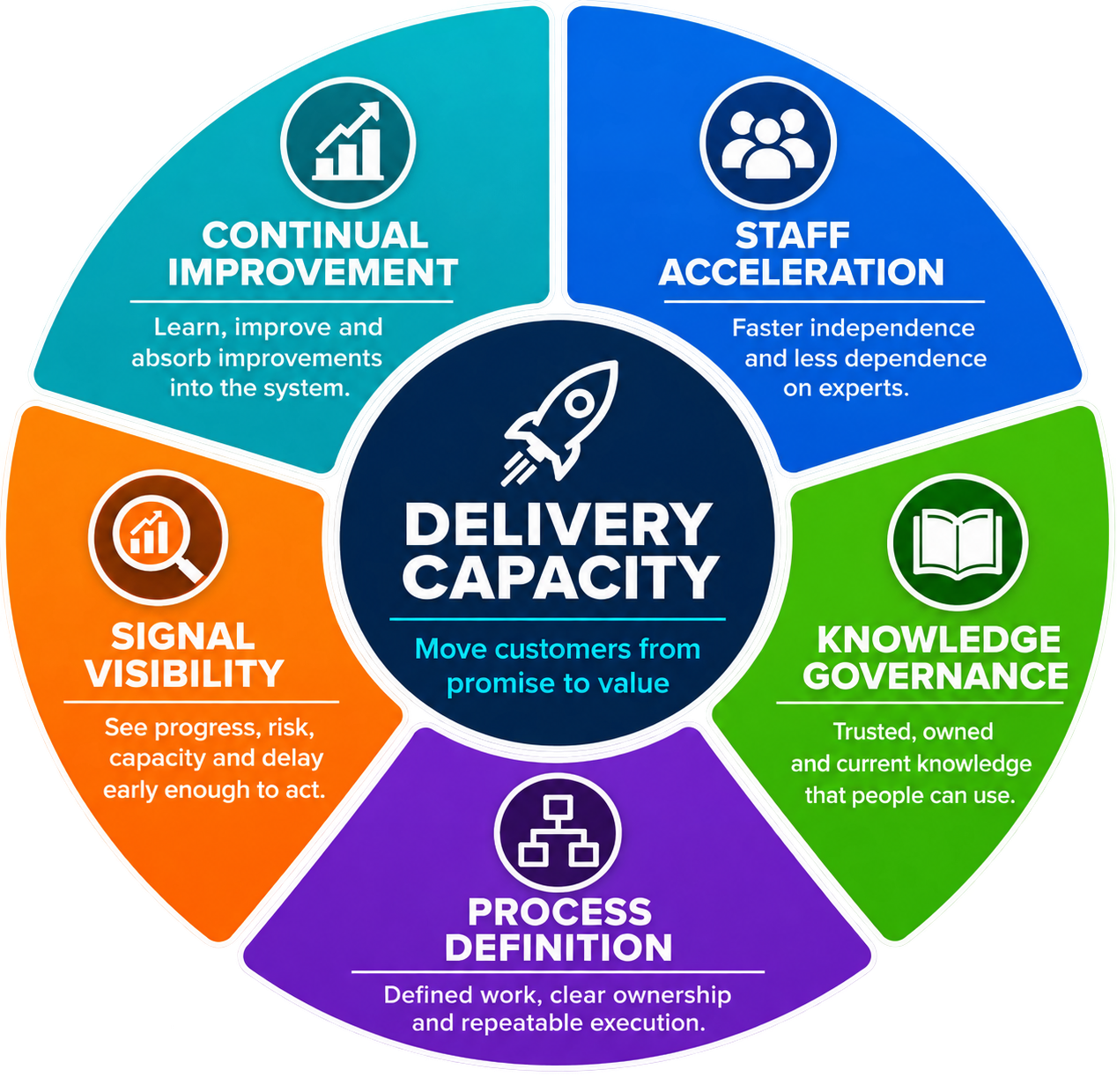
PDL makes customer delivery visible and manageable through five connected operating controls. Each addresses a different source of delivery strain, but the real value comes from how they work together.
People become capable faster because roles, expectations, knowledge, and decision support are available when the work requires them.
Critical knowledge is captured, maintained, trusted, and made usable across the delivery organization instead of remaining inside a few experienced people.
Roles, handoffs, decisions, standards, and customer commitments are clearly defined so execution does not change unpredictably from one project to the next.
Leadership and delivery teams receive timely, meaningful signals that reveal progress, risk, and emerging customer impact before escalation.
Delivery experience is converted into operating knowledge. Patterns, exceptions, decisions, and customer feedback improve the system instead of disappearing when a project ends.
Together, the Five Controls show where delivery capacity is strong, where it remains dependent on heroics or workarounds, and where improvement should begin.
Assess where delivery control is breaking down. PDL builds the customer-onboarding operating system. Once that model moves into live customer work, execution itself becomes the source of the signals needed to manage and improve delivery.

A defined engagement to design, build, and launch the customer-onboarding operating system. Investment established following diagnosis.
Explore the 90-Day ImplementationThe operating layer between your systems of record and the people doing customer-onboarding work.
Learn about OnboardingIQThe assessment examines how your organization prepares people, governs knowledge, defines execution, exposes operating signals, and improves delivery over time.
In about 10 minutes, you receive a structured view of your current delivery capacity and the areas most likely to constrain growth.
See how your organization performs across the five controls that support reliable customer delivery.
Identify the operating pattern creating the greatest exposure to delays, customer risk, and leadership intervention.
Learn which control should be strengthened first to create the greatest improvement in delivery capacity.
The assessment is not a pass-or-fail test. It is a structured way to make delivery capacity visible before deciding what, if anything, needs to change.
Plan Do Launch reflects more than two decades of experience designing, improving, and operating complex customer-delivery systems across software, implementation, product, and regulated environments.
PDL was developed from recurring delivery patterns observed across complex implementation and customer-onboarding environments: capable people working inside systems that depended too heavily on memory, individual judgment, informal knowledge, and executive intervention.
PDL turns those patterns into a practical operating model for identifying where delivery control is weak, where capacity is constrained, and where improvement will create the greatest impact.
Explore How PDL WorksDesigning and improving implementation, onboarding, product, and customer-delivery systems.
Supported through a large-scale rollout designed to create a consistent implementation and learning experience.
Achieved on a major rollout where structure, readiness, and customer experience were treated as one connected system.
Better delivery does not begin with more effort. It begins by making the work visible, governable, and easier for capable people to perform well.
The Delivery Capacity Assessment identifies the structural weaknesses that slow implementations, overload experienced staff, and reduce your organization's ability to scale confidently.