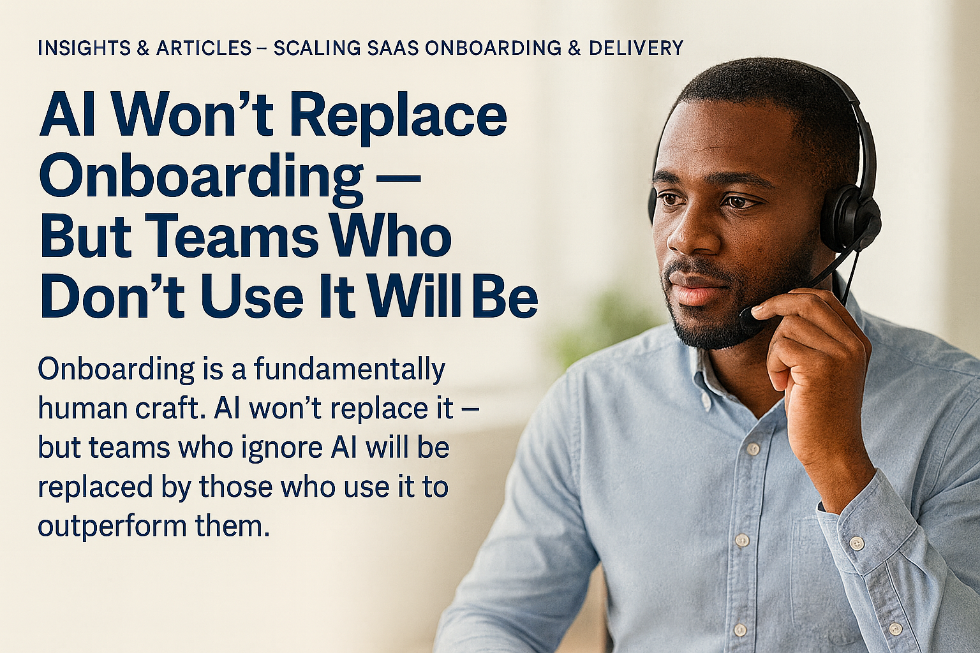
Most AI onboarding conversations start in the wrong place. Teams ask: “How do we use AI to improve our onboarding?” When the more important question is: “Is our onboarding structured enough for AI to actually help?”
Those aren’t the same question. And the gap between them explains why so many AI investments in onboarding underdeliver.
AI Is a Multiplier, Not a Foundation
AI amplifies what already exists in your system. That is the single most important thing to understand about deploying AI in an onboarding operation.
If your onboarding knowledge is structured, current, and governed — AI makes it dramatically more accessible. Team members get contextually accurate answers from the platform. Client communications stay consistent with current product reality. New hires can access structured guidance without needing a senior staff member to translate.
If your knowledge is scattered, outdated, and effectively undocumented — AI makes it more confidently wrong. A language model searching ungoverned documentation returns answers drawn from stale sources. A workflow automation built on top of an ungoverned process produces inconsistent outcomes at machine speed.
The garbage-in-garbage-out principle holds everywhere. It holds especially hard for AI.
The Prerequisite Most Teams Skip: Canon Governance
The single most important structural condition for AI to work in onboarding is Canon Governance — Control 2 in PDL’s Five Controls model.
Canon is not documentation in a shared drive. It’s not a wiki that gets updated when someone remembers. Canon is a structured, version-controlled knowledge system embedded in the delivery platform — one that teams trust because it reflects current reality, and one that updates through a governed process rather than individual initiative.
Without Canon, there is no reliable foundation for AI to work with. Every AI layer you build on top of ungoverned knowledge is drawing from a source that diverged from reality months ago. The tool works. The answers are wrong.
This is why teams report that AI tools are “interesting” but not transformative. They’ve added a powerful tool on top of a weak foundation. The foundation is the problem.
The Five Controls and AI Readiness
AI operates on top of structure. PDL’s Five Controls model establishes that structure — and each control is a prerequisite for AI to deliver value at that layer.
Canon Governance ensures the knowledge layer AI accesses is reliable. Process Definition ensures AI-assisted workflows follow a governed delivery process rather than guesswork. Signal Visibility ensures AI-surfaced alerts are tied to real delivery data, not noise generated from a misconfigured dashboard. Staff Acceleration means new team members are guided by structured, accessible knowledge — not dependent on AI to invent answers from unclear sources. Continual Improvement ensures the system AI operates on gets better each quarter, intentionally, rather than drifting.
Teams that skip the structural work first and layer AI directly on top of an ungoverned operation will find the tools interesting but not compounding. The structure has to come first.
What AI-Enabled Governed Onboarding Actually Looks Like
When Canon Governance is in place and AI is layered on top, specific things become possible that weren’t before. Friction points identified through the quarterly Continual Improvement cycle can be addressed with AI-assisted tooling rather than manual rewrites. Client communications stay current with the product without requiring senior staff to review every interaction. New hires reach productive delivery faster because the knowledge they’re accessing is structured and trustworthy — AI helps surface it, but the governance is what makes it reliable.
This is not automation for its own sake. It is structural enablement — the difference between AI as a novelty and AI as compounding infrastructure.
OnboardingIQ Is Built Canon-First
PDL’s delivery platform, OnboardingIQ, is built with Canon Governance as the foundation before any AI layer is introduced. The knowledge architecture is structured and version-controlled. Updates flow through a governed process. The knowledge system is embedded in delivery workflows — it surfaces in context, where work happens.
That sequencing is intentional. AI that runs on top of a governed Canon is a compounding asset. AI that runs on top of scattered tribal knowledge is a liability that compounds in the other direction.
The teams who will win with AI in onboarding are not the teams who implement AI first. They’re the teams who govern their knowledge infrastructure first — and then let AI compound it.